

SDG 9
AI / Data Centers




Sustainable infrastructure builds more than roads and bridges.
It connects people to clean water, electricity, education, healthcare, jobs and opportunity.
Building resilient infrastructure today lays the foundation for a better tomorrow.
Learn more about #GlobalGoals
https://www.un.org/sust.../infrastructure-industrialization/

Pursuant to Section 33 of the Akron City Charter and Rule 1.2 of the Rules of Procedure for the Akron City Council, you are hereby notified of a Special Council Meeting to be held on Monday, July 27, 2026, at 5:00 p.m. at the Akron City Council Chambers, 166 S. High Street. This Special Council Meeting has been called by President Sommerville.
An open comment public hearing will be held on the following item:
• Ordinance authorizing text changes to amend the Zoning Code to define and regulate data centers.

Save the date for the 2026 Public Interest Law Conference hosted by the Ohio Environmental Council at the Ohio State University September 25! Join community leaders and experts for conversations about the local decisions, laws, and policies responding to the environmental impacts of data center development in Ohio and beyond. Sessions will explore the roles of land use, zoning, community advocacy, judicial decision-making, and state policies in addressing data centers' environmental effects and opportunities. Attendees will leave with a deeper understanding of the legal landscape surrounding data center development and valuable tools they can wield in their own communities. More details to come!

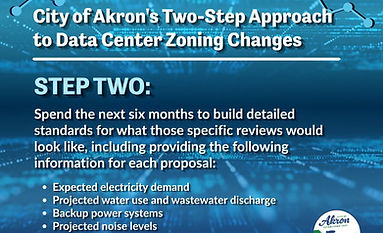
The City of Akron is proposing updates to its zoning code that would establish a clear review process for future data center developments. Under current city law, data centers are allowed in industrial areas by right with no additional review process. This proposed change would require potential data center developers to go through the City’s Planning Commission and Akron City Council for approval.
The City is taking a two-step approach to these zoning changes:
First, we are proposing a requirement that any data center in the city would require specific individualized conditional use approval through City Planning Commission and Akron City Council.
Second, we are going to spend the next sixth months to build detailed standards for what those specific reviews would look like, including providing the following information for each proposal:
• Expected electricity demand
• Projected water use and wastewater discharge
• Backup power systems
• Projected noise levels
Learn more here: https://bit.ly/4vrdMyd
This report, Environmental Cost of Artificial Intelligence: Carbon, Water and Land Footprints, by the United Nations University Institute for Water, Environment and Health (UNU-INWEH) on its 30th anniversary, examines one of the most underexplored consequences of AI’s rapid expansion: the environmental footprints of the energy required to power it. As artificial intelligence becomes embedded in economies, public services, research, communication, and everyday life, it depends on a growing physical infrastructure of data centers, advanced chips, cooling systems, electricity grids, water resources, land, and critical mineral supply chains. The report shows that AI is not only a digital technology, but also a material system with measurable environmental costs.


.webp)
.webp)
The report moves beyond a carbon-only lens by quantifying the carbon, water, and land footprints associated with the electricity used to train, deploy, and operate AI systems at scale. Its central finding is that AI’s environmental costs depend not only on how much electricity is used, but also on where that electricity is generated and which energy sources power it. Every kilowatt-hour used by AI carries carbon, water, and land implications, and these footprints do not always move in the same direction: low-carbon electricity is not automatically low-water or low-land. The report also shows that AI’s footprint is shaped by both major infrastructure trends, including the rapid growth of data centers, and everyday use patterns, including model choice, output length, modality, and the growing use of text, image, and video generation.
Importantly, the report frames AI’s environmental footprint as a governance and justice challenge, not only a technical problem. The benefits of AI often flow across borders and sectors, while the environmental burdens of data center siting, electricity demand, water withdrawals, land use, mineral extraction, and e-waste can be concentrated in specific communities and regions. To address these risks, the report calls for a responsible AI ecosystem grounded in transparency, efficiency by design, equity and environmental justice, lifecycle responsibility, global cooperation, and sustainable use. By making AI’s carbon, water, and land footprints visible and comparable, the report provides a practical basis for integrating AI into energy, climate, water, and land-use planning, ensuring that innovation advances without shifting environmental costs onto vulnerable communities.